Guide + Quote • Bird control
Bird control for buildings and public properties
Pigeons are a persistent nuisance. On apartment blocks, schools, town halls, stations or other buildings, their presence can create serious nuisance, damage façades and increase risks linked to sanitary conditions.
Depigeonnage (bird control) combines methods, devices for protection, on-site inspection and a professional intervention. The goal is to stop the colony, secure high-risk zones, and restore safe, clean and long-term usable spaces.
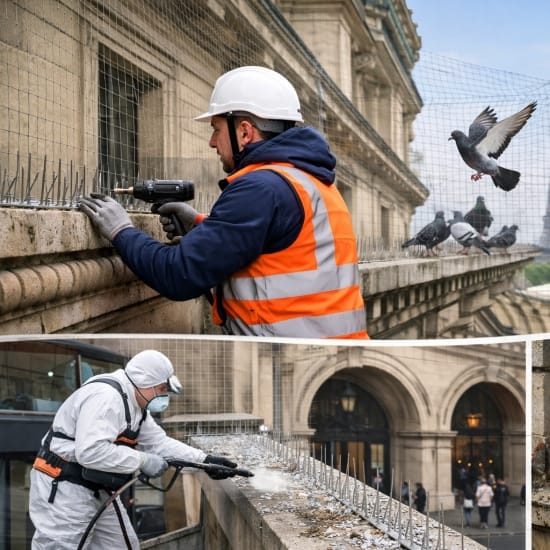
Intervention available 7/7 depending on urgency • Unmarked vehicles • Cleaning, disinfection and restoration.
Why act quickly?
Droppings and bird activity accelerate material wear, create dirt build-up and hygiene issues. Without proper cleaning and disinfection, the site remains exposed to risks for health and broader sanitary concerns.
- Damage to buildings (façades, ledges, cornices)
- More nuisance (noise, stains, odors)
- Sanitary risk: contamination, slippery surfaces, airborne dust
- Site image and user comfort (public spaces, property managers, client areas)
High-risk zones on a building or public property
Effective bird control starts with a survey of landing and nesting zones: ledges, walkways, roof structures, canopies, entrances and parking areas. Each area needs a specific approach.
Bird control methods: which solutions to choose?
There is no single “magic” method. We combine multiple solutions depending on the environment, height, foot traffic, and the level of presence of pigeons.
Spikes and anti-perching systems
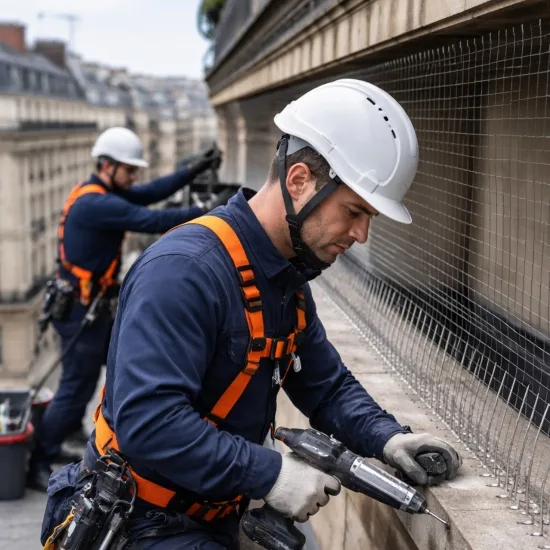
Spikes prevent birds from landing on ledges. A discreet, effective device, often chosen on downtown buildings (for example in Paris).
Protective nets
Nets block access to larger volumes (walkways, canopies, roof voids). Highly effective when a colony uses the site as a “base”.
Repellents & specific add-ons
Repellents can complement other systems depending on constraints. They do not replace proper installation and real inspection.
Deterrence (including sonic systems)
Deterrence (sometimes sonic) may help in certain zones, but must remain compatible with local rules and neighbors.
In short: you don’t “negotiate” with pigeons. You move them, block access, and secure the site for the long term.
Cleaning and disinfection after bird control
Cleaning and disinfection are essential after depigeonnisation. We treat droppings, dust and residues, secure surfaces and restore hygiene.
- Removal of residues + full cleaning of surfaces
- Targeted disinfection (strict sanitary protocol)
- Waste handling and safe access management
- Final check to reduce risks and ensure safety
Regulations: what you should know
Rules vary by city, site type (public/private) and configuration. On public buildings, safety and compliance matter as much as effectiveness. The right move is to call a specialized company used to regulated interventions.
Cost and quote: how much does bird control cost?
The cost depends on the zones, height, the type of devices (spikes, nets…), the size of the colony, and the level of cleaning / disinfection. The simplest option is a quote after a site visit.
Défi Clean operates in Paris and across France with reliable solutions, tailored to each client.
Bird control: methods, risk zones and durable solutions
Pigeons are a common urban nuisance: their presence on a building or public spaces creates ongoing nuisance and requires serious depigeonnage. A well-planned intervention protects sensitive zones (ledges, walkways, rooftops) and improves overall hygiene in the area.
A pigeon settles fast: a colony can develop when the environment is favorable. After depigeonnisation, handling droppings is critical to reduce sanitary impact on health, especially in specific contexts (schools, public buildings, shared properties).
Which methods and devices are used?
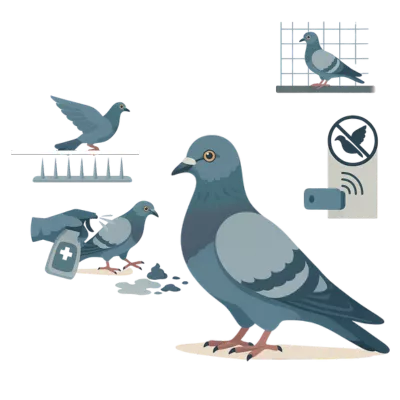
Bird control methods rely on adapted solutions: spikes, nets and other devices for protection. They can be complemented with repellents or deterrence (sometimes sonic), depending on the long-term term objective: short deterrence or durable installation.
- Spikes: prevent landing on ledges and cornices.
- Nets: block access to volumes (walkways, roof voids, structures).
- Extra devices: repellents, deterrence and zone-based solutions.
- Post-work cleaning: removal of droppings and surface securing.
Why hire a professional company?
A professional company ensures safe installation, chooses the right solution, and delivers effective interventions to prevent return of the nuisance. For any client in Paris or elsewhere, the goal is better effectiveness and long-lasting protection.
Cost and quote
The cost depends on access, the type of method and chosen devices (spikes, nets, etc.). Request a quote to validate the selected solutions, the intervention plan and the protection strategy.
FAQ – Bird control for buildings & public properties
What are the best bird control methods?
The most effective approach combines spikes, nets and devices tailored to the zones. Deterrence can be added depending on the site constraints.
What is the average cost of bird control?
The cost depends on access, height, devices to install, the presence of a colony, and the level of cleaning / disinfection. A quote gives an accurate price.
Which regulations apply to bird control?
Rules vary by municipality and site. On public buildings, safety and compliance are essential. A specialized company can guide you based on your specific context.
How can I prevent pigeons from coming back after an intervention?
Install durable protection (spikes, nets), keep strong hygiene, and schedule regular inspection of sensitive zones.
Do I need cleaning after bird control?
Yes. Cleaning and disinfection of droppings reduce risks for health and restore a safe sanitary environment.
Complementary resources
 Main guide
 Techniques
 FAQ
FAQ