


Extreme cleaning in Paris: organising work in an occupied flat
The flat is heavily cluttered, but someone still lives there. Their documents, furniture and personal belongings are not automatically destined for clearance. The first question is not “how much should be thrown away?” but which surfaces can be treated while respecting the occupant’s decisions?
In a Paris apartment building, access to rooms, narrow passageways, stairs and lifts all add practical constraints. Here is how to describe the job without confusing cleaning with sorting possessions or carrying out repairs.
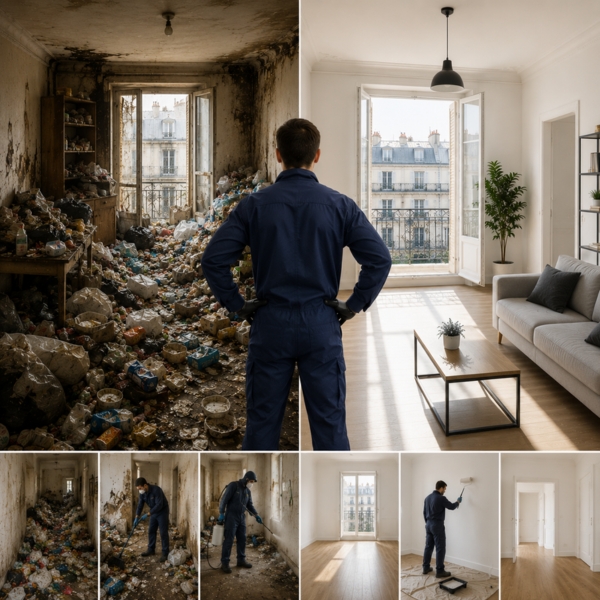
A lived-in room is not simply a space to be emptied
In an occupied home, belongings can have uses that are not obvious. A box beside the bed may hold important papers. A cluttered table might still be used every day. A wardrobe that is hard to reach cannot be treated as abandoned just because it gets in the way of cleaning.
Start by identifying what the occupant wants to keep, what can be moved and which items are still awaiting a decision. If access routes or the condition of the property present a risk, safety must be assessed before deciding whether the person can remain there.
To see where this requirement fits among the services offered, consult extreme cleaning in Paris.
Four situations that require different arrangements
The kitchen is still being used
Distinguish deposits on surfaces from items still needed and fittings that cannot be cleaned without being moved or dismantled. Depending on the conditions identified, work may concern only certain areas.
The hallway is cluttered
The route needs to be assessed without automatically putting its contents on the communal landing. Agree on a suitable place for possessions that are being kept, and never obstruct exits.
Documents are scattered about
They must not be mixed with waste by default. The person entitled to make the decisions can specify which documents to set aside, retain or leave pending approval.
A room is locked or inaccessible
Record it as an area that has not been inspected. Nobody can promise to clean surfaces they have not yet seen or reliably state how many belongings must be moved.
Why the Paris building matters as much as the flat
The route from the flat door to the vehicle can determine what equipment and arrangements are required. Door widths, lift dimensions, landings, stairs, the entrance hall and loading options must all be considered. These vary between buildings: a Paris address alone does not tell you how clearance can be organised.
In a co-owned building, the syndic or managing agent may explain the rules for communal areas. That does not give them the authority to decide what happens to possessions inside the flat. Nor does a relative who holds the keys automatically have the power to empty it.
Where the request mainly concerns accumulated belongings, the hoarder clearance guide explains why sorting, removal and cleaning require distinct decisions.
When Paris bulky-waste collection is not enough
Paris City Council allows private residents to request an appointment-based bulky-item collection at the foot of their building, subject to a 3 m³ limit and exclusions including rubble and cardboard boxes. This service must not be confused with arranging a substantial professional clearance.
The removal of each category of item needs to reflect its status, its nature and the appropriate waste-handling route. Something the occupant wishes to keep is not intended for municipal collection.
Current local rules can be checked on the official Paris City Council waste collection page (in French).
Agree on the stages without promising an outcome in advance
Useful preparation starts with the areas involved, then the permissions required, then the actions that may be possible. This avoids promising a complete clean when some surfaces will remain occupied or when additional treatments still need separate consideration.
- Area to assess: entrance, kitchen, bathroom, bedroom or living room.
- Items to retain: specifically identified furniture, documents and personal effects.
- Pending decisions: items that must not be moved until permission has been clarified.
- Access: floor, lift, passage widths and building rules.
- Limitations: inaccessible surfaces, repairs or treatments not yet defined.
Where the main issue is heavy dirt on surfaces, the very dirty apartment cleaning guide provides further context. Where possessions have accumulated extensively, the Diogenes syndrome cleaning in Paris page distinguishes possible operations without attempting a medical diagnosis.
What to include in an enquiry to Défi Clean
Say whether the flat is occupied, which rooms are affected, what must remain accessible and who is entitled to authorise moving belongings. Mention restrictions along the access route and any areas that have not yet been inspected.
A few photographs may help if they have been taken and shared with the necessary permission. Pictures of people, private documents or intimate details are not needed to explain the practical constraints.
FAQ — Extreme cleaning in an occupied Paris flat
Must the entire flat be emptied first?
No, not as a matter of course. The scope depends on the surfaces concerned, the status of the belongings and the permissions obtained.
Can the occupant stay during the work?
That depends on the risks and operations involved. Staying in the property cannot be guaranteed before the situation has been assessed.
Can a relative decide what to throw away?
Not merely because they are a relative or have the keys. Their authority to decide what happens to the belongings must be checked.
Does the building management have to approve the cleaning?
Work inside the private flat and the use of communal areas are governed by different rules. The syndic can explain the requirements specific to the building.
Can the council take everything from the flat?
No. Municipal collection intended for private residents is subject to limits on volume and categories of items.
Is disinfection always included?
No. It depends on the needs identified and the scope agreed for the work.
What information should I provide with an enquiry?
Describe the rooms, access arrangements, items to preserve, authorised decision-makers and any building restrictions.
Have your Paris flat assessed
A clear description of the areas to be treated and the possessions to preserve helps establish what work may be possible, without pre-empting the occupant’s decisions.
French version: Nettoyage extrême à Paris : appartement occupé.
Leave a Reply