


Investigation & forensics
Crime scene vs accidental death
Behind words like death, crime, homicide or accident, there are very different realities: the type of circumstances, the presence (or not) of intent, the role of investigators, and sometimes a forensic autopsy. This neutral, informational guide explains how a case is classified, how an investigation unfolds, and why some cases take longer to reach resolution.
And yes: even though the topic is judicial, it has very practical consequences for restoring a property. Once investigators release the premises, specialist cleaning can step in to secure the home, protect relatives, and restore the site safely.
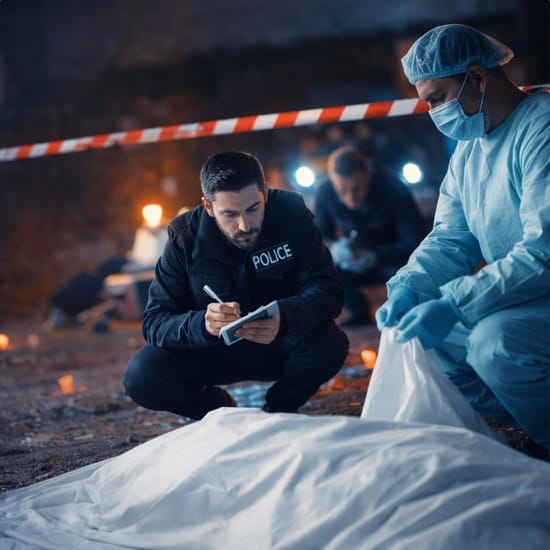
Table of contents
1) Definitions: crime, homicide, accident
A death can have a natural origin, be accidental, or be linked to an act. When we talk about a crime, we enter the judicial sphere: it may involve homicide, murder, a kidnapping followed by violence, or other forms of offence.
Homicide refers to the death of a person caused by another (intentional or not). An accident refers to circumstances where criminal intent is not presumed (even though an investigation may confirm that). Suicide is a separate situation, but it may still involve verification and identification.
The law then distinguishes cases based on the nature of the facts, the causes, and the state of the evidence collected: that’s where the investigation truly begins.
2) Crime scene vs accidental death: what changes
Crime scene
- Possible perpetrator / guilty party to identify.
- Evidence collection to support resolution of the case.
- Intervention by investigators (police; sometimes a judge), with strict procedure.
- Criminal classification: murder, homicide, or another offence.
- Consequences: a potential sentence, sometimes a life sentence.
Accidental death
- An event linked to an accident (fall, fire, poisoning, etc.).
- Verification of circumstances and origin.
- An investigation may exist, but the goal is not necessarily to find a criminal.
- The file can still become judicial depending on the context (liability, insurance).
In both situations, authorities prioritize identification, timeline, and securing the location. The key difference: on a crime scene, every detail can have an effect on the case and its outcome (defense arguments, proof, responsibility, etc.).
3) Key steps of a forensic autopsy
A forensic autopsy aims to understand the causes of death, clarify the nature of injuries, estimate timing, and guide the investigation. It is performed by a doctor within a legal framework.
- Identification and preliminary checks (context, documents, condition of the body).
- External examination: marks, injuries, signs linked to the circumstances.
- Internal examination: search for injuries, organ analysis, sampling.
- Additional tests: toxicology, histology, DNA if needed.
- Conclusion: summary of likely causes and elements useful to investigators.
An autopsy does not automatically mean a crime: it may also be ordered for a complex accident, uncertainty about the origin, or when the victim is a child.
4) Investigation: investigators, police, defense, law
In France, an investigation is organized based on context: a suspicious scene, homicide, murder, a suicide to confirm, or an accident. Investigators (police/gendarmerie) work with experts while respecting the law and procedure. The defense and adversarial process may also take place as the case progresses.
- Goal: understand the circumstances and establish the facts.
- Identify a possible perpetrator and determine intent.
- Classify the offence and assess criminal consequences (the sentence).
- Support resolution of the case within a legal framework.
In some files, several cases overlap: statements, reconstructions, expert reports, and sometimes changing leads between the first observations and the conclusion.
5) Cold cases: why they’re harder to solve
A “cold case” (an unresolved case over a long period) brings challenges: evidence disappears, memories fade, technology evolves, and new tests become possible. These cases can have a major effect on the life of relatives and on society.
Factors that make a homicide harder to solve include: few witnesses, a compromised scene, a mobile criminal, early mistakes, or a lack of usable evidence. Sometimes a new lead revives the file “years later” (that “year” variable again…).
After the investigation: restoration and specialist cleaning
Once the location is released by investigators, priorities become sanitary and human: securing, disinfecting, and restoring the premises. That’s where professional intervention matters, especially when there are biological risks, persistent odors, or areas requiring deep treatment.
For specialist cleaning services, see our pillar page: Crime scene cleaning.
FAQ – Crime scene, accidental death, autopsy
What are the steps of a forensic autopsy?
Identification, external examination, internal examination, sampling and additional tests, then a forensic conclusion to guide the judicial investigation. The autopsy is carried out within a legal framework by a doctor.
How is a cold case handled?
A file may be reviewed or reopened if new elements appear: testimonies, cross-checking, scientific progress, or links with other cases. The goal is to move toward resolution.
What makes a homicide more difficult to solve?
Limited evidence, a degraded scene, contradictions, time passed, or a difficult-to-identify perpetrator. Each detail can influence classification (murder vs homicide) and the final sentence.
Why does the difference between a crime scene and an accidental death matter?
Because it changes everything: procedures, the role of investigators, evidence collection, criminal law classification, and the human stakes around the victim.
Need advice or an intervention?
If you are facing a death (accidental or otherwise) and the property must be restored after the authorities have completed their work, contact a specialist team. We can advise you quickly and discreetly.
Essential resources
 Main guide
 FAQ
FAQ
 Compliance
Story – Understanding homicide, criminal acts, and judicial investigations
A homicide is never just a news item. As soon as a lifeless body is discovered, investigators must determine whether the death resulted from an accident, suicide, or a deliberate act. Every person involved, every victim, every corpse becomes the starting point of complex judicial work.
When homicide is suspected, the first step is to secure the location and allow forensic teams to operate. The body is examined, photographed, then entrusted to a forensic doctor for an autopsy. This forensic autopsy helps analyze the nature of injuries, identify the causes of death, and determine whether there is criminal intent behind the act.
In some types of crimes, such as murder, kidnapping, or aggravated murders, the investigation aims to establish the role of the perpetrator, identify the guilty party, and understand the context of the victim’s life. The objective is to reconstruct events from the first gesture to the final consequences, in order to legally classify the homicide.
Crimes can be classified into several types: intentional homicide, involuntary homicide, murder, or premeditated criminal homicide. Each classification leads to a specific sentence, potentially up to a life sentence. Criminal law also distinguishes situations involving a child, where severity is heightened and the judicial response is stricter.
The role of the police officer and judicial services is central. They work between cross-checking, interviews, and scientific analysis to understand the chain of events. Some cases remain ongoing for years and sometimes become unresolved files, where criminal leads stay open.
In a criminal case, the autopsy can reveal decisive elements: time of death, the mechanism of the act, traces left on the body, or signs of defense. This information can guide investigators toward a potential criminal and confirm whether the death truly involves homicide or an accident.
Every homicide is a confrontation between life, death, and justice. Behind every corpse, there is a person, a victim, sometimes a child, and always a truth to establish. Understanding these mechanisms also helps us grasp the human, judicial, and social stakes behind crimes and criminal cases.
Related resources
The service
Read next
- Suicide Cleanup: Biological Safety Protocols →
- FAQ – Crime Scene Cleaning →
- The steps of crime scene cleaning →
Other situations
- Suicide cleanup services →
- Death cleanup services →
- Guide: cleaning up after a death →
- Unsanitary house cleaning →
- Our work: before & after →