

Pigeon control, anti-bird protection & droppings cleaning
Défi Clean protects buildings from pigeons with humane deterrents — spikes, netting and exclusion systems — then removes the droppings and disinfects every affected surface.
Ledges, roofs, balconies, atriums, walkways, warehouses and public spaces: each job is scoped after a site assessment, with no destruction of birds.
- bird spikes
- netting
- wire & electric systems
- ultrasonic deterrents
- droppings removal
- disinfection
- managed buildings
- Paris & France
Why bird control matters
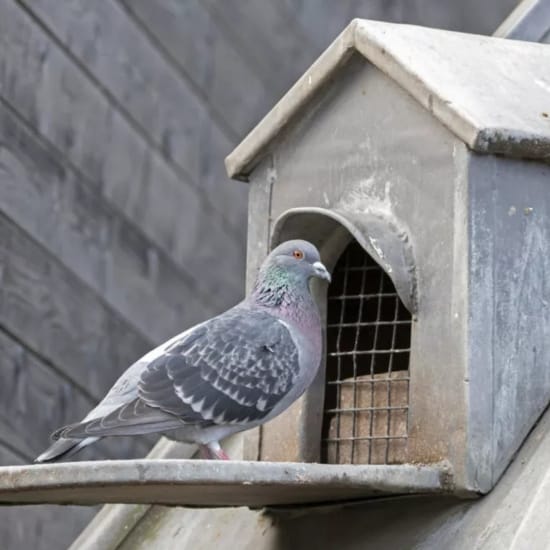
An established colony is more than a visual nuisance. Droppings build up, nests block rainwater downpipes, and materials degrade season after season.
Pigeon droppings are acidic and highly corrosive: they attack stone, zinc, paint and joints, and can lead to water ingress and structural damage.
- Nuisance on facades, roofs, walkways and entrances
- Health risks: droppings can harbour bacteria, fungal spores and respiratory pathogens
- Building damage from corrosion and blocked drainage
- Slip hazards on terraces, stairs and access balconies
- Associated parasites carried in nests (mites, bird fleas)
- Legal framework: exclusion and humane solutions come first
When should you act?
The longer a colony stays, the more hardware is needed to move it on. Signals worth acting on:
- Recurring droppings under a ledge or balcony
- Visible nests in lofts, ducts or signage
- Rainwater downpipes blocked by feathers
- Complaints from residents, staff or visitors
Read more: why bird control is essential for public health.
Deterrents & protection systems
There is no single answer. The right system depends on the surface, the height, the look you need to preserve and how much pressure the colony puts on the building.
Bird spikes
Stainless steel or polycarbonate spikes on ledges, signage, railings and sills to stop birds landing, without injuring them.
Protective netting
Netting across atriums, canopies, courtyards, warehouses and soffits: the most effective barrier on large volumes.
Wire & electric systems
Low-profile tensioned wire or low-intensity tracks along landing lines, discreet from street level and suited to heritage facades.
Ultrasonic & repellents
Ultrasonic units, gels and sprays to secure an occupied area, or as an interim measure before permanent hardware is installed.
Full comparison: modern bird control techniques — netting, spikes and ultrasonics.
Droppings removal & disinfection
Excluding the birds is only half the job. Dried droppings turn into inhalable dust, so cleaning uses specific equipment and products — the challenge being to raise as little dust as possible.
Our technicians work in personal protective equipment, wet down every surface before brushing, and remove waste through an appropriate disposal channel.
Detailed protocols: disinfection after pigeon proofing and droppings cleaning on roofs and balconies.
The protocol in short
- Zone marked off and surroundings protected
- Surfaces wetted down to prevent airborne dust
- Nests and accumulated waste removed
- HEPA vacuuming and wet brushing
- Application of a biocidal treatment
- Rinse, dry and final inspection
Cleaning, sanitizing & disinfecting — our process
The three words are often used interchangeably. They are not the same thing, and the order matters.
- Clean: remove soil and organic matter, then rinse with water and suitable detergents. Disinfectant applied on a dirty surface simply does not work.
- Sanitize: bring the microbial load on the surface down to a safe level, using antimicrobial detergents.
- Disinfect: apply a virucidal product and respect the full dwell time needed to kill the target organisms.
- Verify: inspect the treated areas, document the intervention and hand over maintenance advice.
Who we work with
Businesses & industry
Head offices, warehouses, logistics sites and plant rooms where droppings threaten equipment and hygiene.
Property managers
Courtyards, balconies, stairwells and roofs, with a quote suited to building-committee approval.
Public buildings
Schools, hospitals, stations and retail, where the health and safety of users comes first.
Landlords & agents
Scattered rental portfolios, make-good before reletting, and handling of resident complaints.
Private owners
Roofs, terraces, balconies and conservatories, on houses and apartments alike.
Local authorities
Parks, squares, monuments and street furniture, using methods that respect the birds.
Large sites and public estates: bird proofing for apartment blocks and public buildings.
Facility & food-area hygiene
Where a site includes catering or food preparation, bird proofing is only part of the picture. We add compliant workflow hygiene so that prep zones stay usable throughout the works.
- Corporate catering areas with surface sanitizing and equipment checks
- Mobile cleaning and sanitizing units for events
- Kitchen sterilization cycles: rinse, disinfect, rinse
- Post-service disinfection in line with food safety rules
Food-contact surfaces
Food-contact areas follow their own rules: specific products, controlled dwell times and a mandatory potable-water rinse before the area is handed back.
We document each cycle so your own hygiene records stay complete.
Bird control in Paris and across France
Based in the Paris region, we work across Paris itself, the surrounding départements, and travel to sites throughout mainland France.
Legal framework and an ethical approach
Bird control means keeping birds away, not destroying them. Our work relies on exclusion and deterrence hardware, never on brutal or improvised methods.
Depending on the site, specific permissions may be required — particularly on listed buildings, in conservation areas, or where species other than the feral pigeon are present. We check that framework before every job.
What our clients say


Essential resources

Public health & risks
Why acting early matters: nuisance, droppings and health hazards.
Read the article →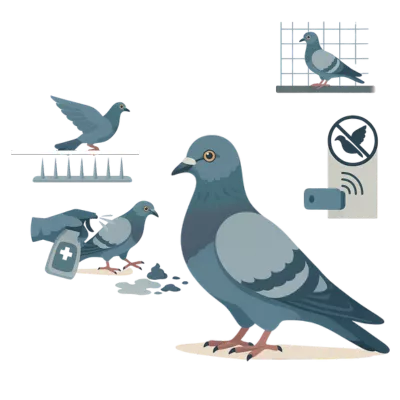
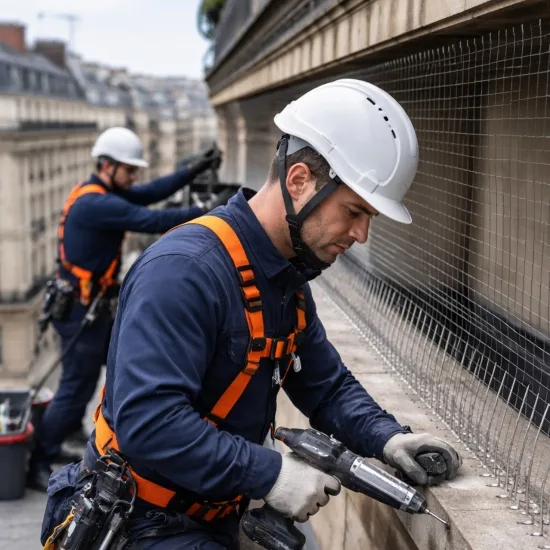
Défi Clean story — a residential block overrun by pigeons
In a large residential block in the city centre, residents had had enough. Balconies, window ledges and roofs were occupied day and night. At first some found the birds almost endearing… then the droppings, feathers and nests began to pile up.
The managing agent was left facing their own responsibility: protecting the people living there and limiting the health risks. Communal areas, the entrance hall and the stairwells were soiled again and again, and children were playing under heavily fouled ledges.
That was the point at which the block called Défi Clean. On the first visit, the technician took the time to explain the approach: limit the colony, secure the sensitive areas and restore a healthy environment, while genuinely respecting the animals and the applicable health rules.
No brutal or improvised action: deterrence, netting and wire along the landing lines, a full clean and then disinfection. A few weeks later the balconies were usable again and the communal areas were clean.
FAQ — bird control & disinfection
What is the difference between cleaning, sanitizing and disinfecting?
Cleaning removes soil and organic matter. Sanitizing lowers the microbial load on a surface to a safe level. Disinfecting kills most bacteria and viruses on non-porous surfaces, using a virucidal product left in place for its full dwell time. The three steps run in that order — a disinfectant applied to a dirty surface will not work.
Are bird droppings dangerous to health?
Yes. A significant build-up of droppings can harbour bacteria, fungal spores and respiratory pathogens. Dried droppings turn into inhalable dust, which is why removal is always carried out with protective equipment, wetted surfaces and a full disinfection afterwards.
Which deterrents and systems do you install?
Bird spikes, protective netting, tensioned wire and low-intensity track systems, plus ultrasonic units, gels and sprays. Each solution is matched to the surface, the height and the configuration of the site, for lasting exclusion that does not harm the birds.
Do your systems injure the birds?
No. Spikes, netting and wire systems are exclusion devices: they prevent landing and nesting without injuring the birds. We do not carry out culling.
Do you serve all of France?
Yes. Défi Clean operates across mainland France — Paris, the Île-de-France region and every major city. Our technicians travel to sites that are difficult to access or at height.
How much does bird control cost?
Pricing depends on the linear metres to be protected, the type of system, the working height, the access method (cherry picker, rope access, scaffolding) and the volume of droppings to remove. Only a site visit or a detailed set of photographs allows a reliable figure; the quote is free.
Do we need permission to install netting or spikes?
In a managed building, installing hardware on communal areas usually requires a decision by the owners’ committee. On a listed building or in a conservation area, a planning permission may be needed. We tell you which steps apply to your site.
How often should surfaces be disinfected?
Daily sanitizing is appropriate for high-touch points. Scheduled disinfection is typically weekly, or immediately after a contamination event, based on a risk assessment of the site.
Can the birds come back after the works?
They can, if landing points remain accessible or if a food source persists nearby. That is why we treat every landing line and hand over maintenance advice: see how to prevent reinfestation.
Need bird control or disinfection?
Tell us about the site and send photographs where possible. We assess the configuration, the access conditions and the volume to treat, then send you a free, detailed quote.
7 days a week, 8:30am – 9pm • Paris and mainland France