


Diogenes Syndrome in France: Who to Contact?
When someone shows signs of Diogenes syndrome, there is no single number to call. The right contact depends on the situation. What matters: the person’s health, the risks in the home, whether they accept help, who owns the property and what needs to be done.
Are you worried about a parent, a neighbour or a tenant in France? It is normal not to know where to start, especially if you live abroad or are new to the French system. This guide explains who to contact about Diogenes syndrome, step by step, and what each French service actually does.
A cleaning company does not make medical diagnoses. Its role is limited to the home and the work it is asked to carry out.
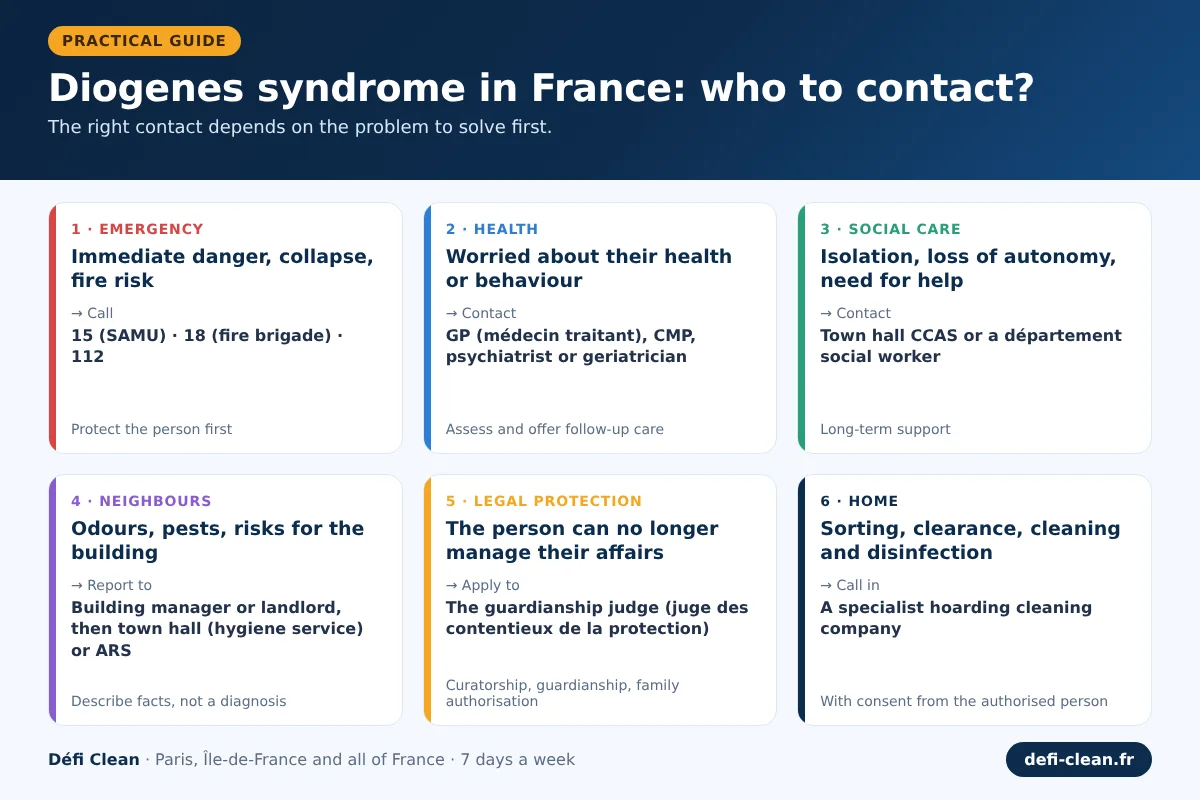
Who should you contact first about Diogenes syndrome?
The first contact depends on what needs attention right now.
Diogenes syndrome: what to do and who to contact? The key points:
- Immediate danger (collapse, fall, fire risk, person not responding): call 15 (SAMU, medical emergencies), 18 (fire brigade) or 112.
- Concern about their health: their GP (médecin traitant), or the local CMP (public mental health centre).
- Isolation, loss of autonomy, need for support: the CCAS at the town hall, or a social worker from the département.
- Odours, pests or risks affecting neighbours: the town hall (municipal hygiene and health service, where there is one) or the ARS, the regional health agency.
- The person can no longer manage their affairs: the guardianship judge (juge des contentieux de la protection), for a possible curatorship or guardianship.
- A home to sort, clear and clean: a specialist hoarding cleaning company.
Before you pick up the phone, ask yourself five questions.
- Is anyone in danger today? If so, emergency services come first.
- Does the person accept help, even partly?
- Who has the right to decide about their belongings: the person, a relative, a curator or a guardian?
- Do they own or rent the home, and is the building affected?
- Is a professional already involved: doctor, home help, social worker?
Your answers almost always point to the first contact to call.
Outside emergencies, a doctor can assess the person’s condition. Social services step in when an isolated person struggles at home or in daily life. When the main problem is clutter, waste or hygiene, a specialist company can assess the practical work needed.
Each has its own role. Together, they complement each other.
Diogenes syndrome: who to contact depending on the situation?
Start by identifying the problem to solve, then choose the right contact.
| Situation | Who to contact in France | Main role |
|---|---|---|
| Medical problem or worrying health | GP (médecin traitant) or health professional | Assess the person and refer them if needed |
| Immediate danger | Emergency services: 15, 18 or 112 | Protect the person and handle the emergency |
| Isolation or serious social difficulties | Town hall CCAS or département social services | Assess social needs and arrange support |
| Psychological or psychiatric follow-up | CMP, psychiatrist or geriatrician | Offer appropriate, long-term care |
| Very complex situation | Health, social and care professionals involved | Coordinate the different services |
| Very cluttered or very dirty home | Specialist hoarding cleaning company | Assess sorting, clearance and cleaning |
| Unsanitary conditions beyond clutter | Town hall (hygiene service) or ARS, depending on the town | Look into procedures related to the home |
| Person who can no longer manage their affairs | Guardianship judge (juge des contentieux de la protection) | Decide on a possible curatorship or guardianship |
| Rented home | Occupant, landlord or legal representative | Clarify responsibilities and authorisations |
| Shared areas in a co-owned building | Building manager (syndic) | Organise decisions about common areas |
| Worried neighbour or nuisance in the building | Syndic, landlord, town hall or CCAS | Report the facts and trigger an assessment |
Not every contact needs to be involved. It all depends on the context.
How to help someone with Diogenes syndrome
Start by noting the facts, without trying to make a diagnosis yourself.
Look at whether some rooms have become hard to access, whether waste or objects have built up, whether hygiene has seriously declined, or whether the person no longer manages essential tasks alone.
The goal is not to label the person, but to understand the real difficulties they face. A gradual approach usually works better than a decision taken without them, when they are able to take part.
If cleaning or clearance is planned, relatives must first establish who is allowed to decide what happens to the belongings in the home.
A few attitudes make the conversation easier:
- Talk about safety and comfort rather than dirt or shame.
- Offer help with one room or one specific problem: access to the kitchen, the bathroom, an exit.
- Involve their GP, whom the person often already knows.
- Keep a written record of the steps taken and the people contacted.
- Plan for afterwards: home help, regular visits, social follow-up, to reduce the risk of things piling up again.
Should you contact social services?
Social services are useful when hoarding comes with isolation, loss of autonomy or support needs that go beyond cleaning the home.
In France, the CCAS (centre communal d’action sociale, the municipal social action centre at the town hall) is often the simplest entry point for a relative or neighbour. It can direct you to a social worker, home help, meal delivery or a personal alarm service.
The APA (allocation personnalisée d’autonomie) is an allowance for people aged 60 or over who are losing autonomy. Paid by the département, it can fund home help once the home has been restored.
For complex cases involving many professionals, coordination support services (DAC) can take over. Their role is not to replace the family or the cleaning company, but to organise support when several difficulties add up.
Should you contact a doctor?
A doctor is the right contact when the person’s health or behaviour needs to be assessed.
“Diogenes syndrome” describes a complex situation that can combine several difficulties. A heavily cluttered or neglected home is not enough, on its own, for a cleaning company or a relative to make a diagnosis.
The GP (médecin traitant) is usually the first contact, because they know the person. They can refer them to a psychiatrist, a geriatrician or the local CMP (centre médico-psychologique). CMP consultations are free at the point of care. Some psychiatric teams can make home visits.
Does the person refuse all care despite a serious risk to their health or safety? Only health professionals can then judge whether care without consent can be considered, within the framework set by French law.
Défi Clean deals with the physical condition of the home. Medical assessment belongs to health professionals.
When should you contact the town hall?
The town hall (mairie) or the relevant services may be involved when the home raises questions of unsanitary conditions, safety or nuisance beyond the inside of the home.
It is important to distinguish Diogenes syndrome from an administrative procedure for an unsanitary home. A very cluttered home may need heavy cleaning without automatically falling under an unsanitary housing procedure.
Depending on the town, your report is handled by the municipal hygiene and health service (SCHS), found in many cities, or by the town’s public health department. Elsewhere, the mayor relies on the local office of the ARS. A written report describing observed facts (odours, pests, leaks, fire risk) is more useful than simply saying “Diogenes”.
To find out who to alert about unsanitary housing, read our guide who to contact about an unsanitary home.
Reporting Diogenes syndrome: neighbours, landlords and building managers
A neighbour, caretaker or landlord is often the first to notice. Persistent odours, insects or rodents, piling mail, an occupant nobody sees any more: these are warning signs. The right reflex is to report specific facts, not a diagnosis.
- Neighbour: inform the building manager (syndic) or landlord in writing, then the town hall (CCAS or hygiene service) if the nuisance continues.
- Landlord or owner: remind the occupant of their duty to maintain the home, and involve social services before starting any procedure.
- Building manager: deal with the common areas and alert the town hall when the building’s hygiene is at stake.
- Anyone who is worried: call emergency services if there is danger. Social services or the public prosecutor (procureur de la République) can be alerted when a vulnerable adult seems to be at risk.
Entering another person’s home without their consent is not allowed, even for a relative. You need the consent of the occupant or their legal representative, a court decision, or an emergency intervention by the services.
Template message to alert the CCAS or the town hall
A short, factual message is handled better than a long account. Messages to French services should be written in French; here is a model you can adapt (an English version follows each line).
Objet : Personne en difficulté dans son logement – demande d’évaluation (Subject: Person struggling in their home – request for an assessment)
Bonjour,
Je me permets de vous signaler la situation de [prénom, nom], qui vit au [adresse]. Je suis [son fils, sa voisine, son bailleur…]. (I am writing about [name], who lives at [address]. I am [their son, neighbour, landlord…].)
Depuis [durée], j’ai constaté : [accumulation d’objets, odeurs, nuisibles, courrier non relevé, isolement]. La personne [accepte / refuse] pour l’instant toute aide. (For [time], I have noticed: [build-up of objects, odours, pests, uncollected mail, isolation]. The person currently [accepts / refuses] help.)
Pourriez-vous m’indiquer le service compétent et les démarches possibles ? Je reste joignable au [téléphone]. (Could you tell me which service is responsible and what can be done? You can reach me on [phone].)
Cordialement,
[Votre nom]
Keep a copy of every message you send. These records help if the situation is later reviewed by a doctor, a judge or a landlord.
When should you call in a hoarding cleaning company?
A specialist company can help when practical work is needed in the home: sorting, decluttering, clearance, waste removal, deep cleaning or treatment of heavily soiled areas.
The company first needs to know which tasks are authorised and who can make decisions about the belongings.
A home may contain official papers, photos, keepsakes, clothes, furniture or objects whose value cannot be judged at a glance. Défi Clean does not decide in place of the occupant or their family what should be thrown away.
Instructions about belongings must come from the person concerned or from the person authorised to decide.
Why you should not start by emptying everything
Emptying everything without sorting can mean losing documents, memories or belongings the person wanted to keep.
When the build-up is severe, the sheer volume can make everything look like waste. That is not necessarily the case.
At a minimum, separate:
- Items clearly meant to be kept.
- Objects that need a decision.
- Documents and personal effects.
- Identifiable waste.
- Items whose status is not yet decided.
This separates decisions about belongings from the practical cleaning work.
Diogenes syndrome and hoarding disorder: who does what?
Hoarding disorder and Diogenes syndrome are not interchangeable terms.
Hoarding disorder mainly refers to difficulty parting with possessions and excessive accumulation. Diogenes syndrome describes more complex situations that can combine severe self-neglect, neglect of the living environment and isolation. Read more on hoarding disorder.
In both cases, a cleaning company only handles the practical tasks it is given. Health, psychological or social support belongs to the relevant professionals.
What if the person refuses cleaning?
A refusal does not automatically give a relative the right to empty the home.
The first question is who can legally and practically decide what work is done. When the person lives in their home and can still make their own decisions, their choices must be respected.
Other people or bodies may become involved depending on the person’s condition, the status of the home, an existing protection measure or an identified danger.
Défi Clean therefore asks the person organising the work to state their role and the scope of decisions they are authorised to make.
Curatorship or guardianship: when to apply to the judge?
A person may no longer be able to look after their own interests because their faculties are impaired. A legal protection measure can then be requested from the guardianship judge (juge des contentieux de la protection) at the court (tribunal judiciaire) where they live.
- The application can come from the person, their spouse or partner, a relative, someone with close and stable ties to them, or the public prosecutor, often alerted by social services.
- It must include a detailed medical certificate from a doctor on the list drawn up by the prosecutor.
- The judge chooses the least restrictive measure possible: temporary court protection (sauvegarde de justice), family authorisation (habilitation familiale), curatorship (curatelle) or guardianship (tutelle).
Once the measure is in place, the curator or guardian becomes a key contact. Within the limits of their role, they can authorise sorting, clearance and payment for the cleaning.
Diogenes syndrome: support and financial help in France
Cleaning a hoarder’s home is normally paid for by the occupant or their family. Depending on the situation, financial help can reduce the remaining cost:
- Discretionary aid from the CCAS or emergency assistance from the département.
- Social action funds from pension schemes and supplementary pension funds.
- Assistance cover from some health insurers (mutuelles) or home insurance policies.
- The budget managed by the curator or guardian when the person is under legal protection.
- A contribution from a social landlord in some cases.
Details are in our guide to financial aid for unsanitary home cleaning. To estimate the budget, see our hoarding cleaning costs and prices.
How to prepare a cleaning request
Before calling us, take five minutes to note a few simple facts. This lets us reply quickly and accurately.
You can tell us:
- The type of home.
- The rooms concerned.
- How cluttered it is.
- Whether there is waste or heavy soiling.
- Any access difficulties.
- Whether the occupant is present.
- Who decides about the belongings.
- Items that must be kept.
No need to find the right medical term: describe what you see. Photos, if the person agrees, also help us prepare the quote.
What is Défi Clean’s role?
Défi Clean handles cleaning and clearance work related to the condition of the home.
Depending on what is agreed with the person, their family or the authorised client, the work can include sorting authorised items, clearance, waste removal and cleaning of the affected surfaces.
The company works with its own salaried team and pays particular attention to discretion and respect for the people involved.
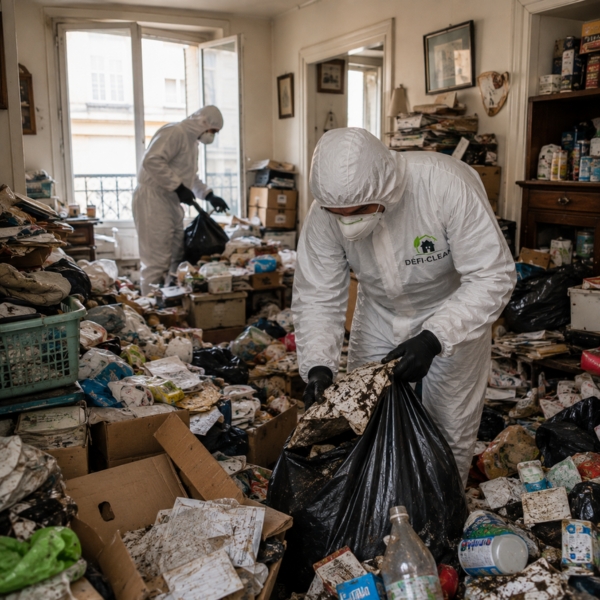
As a specialist hoarding cleaning company, Défi Clean works in Paris and across Île-de-France, and travels anywhere in France, 7 days a week. The free quote is based on your description of the situation or on a visit. See also our pages on Diogenes cleaning in Paris and hoarder clearance.
Défi Clean does not make medical diagnoses and does not replace health professionals or social services.
FAQ: who to contact about Diogenes syndrome
Who should I call first about Diogenes syndrome in France?
It depends on the most urgent problem: health, social isolation, danger in the home or cleaning. A GP, social services (CCAS), emergency services (15, 18, 112) or a specialist company each have a different role.
Can a cleaning company diagnose Diogenes syndrome?
No. A cleaning company deals with the physical condition of the home and does not make medical diagnoses. It can note clutter, waste or soiling and define the cleaning work needed.
Can social services help someone living in a heavily cluttered home?
Yes. The CCAS at the town hall or the département social services can help when a person struggles with autonomy, isolation or daily life. The exact contact depends on the town and on any support already in place.
Can I clear a relative’s home without their consent?
No. A relative should not assume they can decide what happens to the belongings. You must identify who is authorised to approve sorting, clearance and removal before any work.
Should I contact the town hall about Diogenes syndrome?
The town hall may be involved when the home also raises unsanitary, safety or nuisance issues handled by its services. It is not automatically the first contact for every Diogenes situation.
How do I report Diogenes syndrome in France?
Describe specific facts (odours, pests, visible build-up, isolation) to the CCAS or the town hall hygiene service. In an emergency, call 15, 18 or 112. A neighbour can also alert the building manager or landlord in writing.
What should I do if my neighbour has Diogenes syndrome?
Avoid confrontation. Report the nuisance to the building manager or landlord, then to the town hall if it continues, and inform the CCAS if the person seems isolated or in difficulty. Never enter the home without consent.
Who pays for cleaning a hoarder’s home?
Normally the occupant or their family. Financial help from the CCAS, the département, a pension fund, a health insurer, or the budget managed by a curator or guardian can reduce the cost.
Is curatorship or guardianship always needed?
No. A protection measure is requested from the guardianship judge only when the person can no longer look after their own interests, with a detailed medical certificate.
How do I contact Défi Clean about a hoarder’s home?
Use the Défi Clean contact page and choose “Get a free quote” or “Contact us”. Briefly describe the condition of the home, the rooms concerned and who is authorised to decide about the belongings.
Describe the situation in the home
From the contact page, choose Get a free quote or Contact us. Tell us the rooms concerned, how cluttered the home is and who is authorised to decide about the belongings.