

Difference Between Unsanitary Housing and Hoarding Disorder
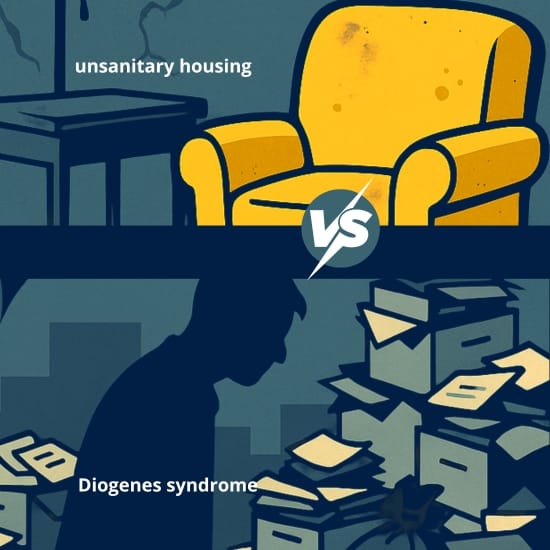
The term unsanitary housing is often confused with the hoarding disorder. Yet, these two situations — while visually similar — have very different causes and consequences. Défi Clean helps you understand the distinction to better identify the right intervention and support.
What Is Unsanitary Housing?
Unsanitary housing refers to a living space whose conditions endanger the health or safety of its occupants. It may result from humidity, mold, poor ventilation, pest infestations, or prolonged lack of maintenance.
- Presence of mold, fungi, or pests.
- Structural issues such as leaks, cracks, or excessive humidity.
- Insufficient hygiene making the place unfit for living.
👉 Unsanitary housing can affect any home, even without any underlying psychological disorder.
Hoarding Disorder: A Behavioral Origin
Hoarding disorder is a behavioral condition that leads to the extreme accumulation of objects, waste, and a deep neglect of hygiene. It often comes with social isolation and a refusal of outside help.
- Compulsive hoarding of objects or garbage.
- Isolation, shame, and psychological disconnection.
- Health hazards related to accumulated waste.
Unsanitary Housing vs. Hoarding Disorder: How to Tell the Difference?
Unsanitary Housing
- Caused by material or environmental factors.
- Maintenance issues, humidity, or pests.
- Not necessarily linked to a psychological condition.
Hoarding Disorder
- Psychological and behavioral origin.
- Pathological accumulation of objects and waste.
- Requires human, medical, and social support.
Tailored Cleaning and Support
At Défi Clean, we handle both situations with care and professionalism:
– Extreme cleaning and disinfection of unsanitary homes,
– Clearance and full restoration after hoarding disorder,
always carried out with discretion, respect, and safety.
Key Differences — Summary Table
| Aspect | Unsanitary Housing | Hoarding Disorder |
|---|---|---|
| Origin | Technical & hygiene issues (damage, humidity, pests) | Psychological & behavioral (accumulation, denial, impaired executive functions) |
| Signs | Widespread dirt, odors, mold, electrical hazards | Masses of objects, blocked pathways, refusal of help, social withdrawal |
| Risk | Health and domestic safety | Health + psychological distress + social isolation |
| Key Stakeholders | Owner/tenant, city hall/public health agency, contractors, cleaning company | Medical (doctor, geriatric psychiatry), social services (welfare office), and specialized cleaning company |
| Solution | Sanitation, repairs, disinfection | Step-by-step intervention: support + clearance, decluttering, disinfection, deodorization |
It’s possible to have both at the same time — hoarding often leads to major unsanitary conditions. The response must therefore be coordinated.
Signs and Risks to Identify
Common Signs
- Strong odors, pests (cockroaches, rodents), and mold.
- Blocked pathways and exits (risk of fire or falls).
- Poor air quality, excessive objects and packaging.
Specific to Hoarding Disorder
- Compulsive accumulation following an “internal logic”; inability to discard items.
- Denial, refusal to let anyone in, shame, isolation.
- Possible cognitive impairment (dementia, trauma) or mood disorders.
What to Do in Practice
- Assess without confrontation: check immediate safety (electricity, exits), and health risks.
- If hoarding is suspected: alert the general practitioner or geriatric psychiatry department; coordinate with social services.
- Call a specialized team: hoarding cleaning service (decluttering, clearance, disinfection, deodorization).
- If unsanitary housing: inspection and unsanitary home cleaning, pest treatment, and repairs.
- Need an estimate? See price ranges and how to choose a cleaning company.
Défi Clean operates throughout France: inspection, clearance, disinfection, and full restoration.
Learn More
Related resources
The service
Read next
- How to Get a Reliable Quote & Choose a Hoarding Cleaning Company →
- Diogenes Cleaning Procedure: Method, Safety & Results →
- Hoarding Cleaning Costs & Prices in France →
- How Diogenes syndrome affects daily life and housing →
- Diogenes syndrome cleaning: risks, procedure & support →
- FAQ — Diogenes Cleaning →
- Hoarding Disorder & Diogenes Syndrome: Causes, Symptoms & Treatment →
- Definition of Diogenes syndrome: understanding this behavioural disorder →
Other situations
Request a free quote